In the tertiary realm, learning space discourse over the last twenty years has been vexed by the question Do students actually learn better in Collaborative Classrooms compared to traditional classrooms such as lecture theatres and tutorial rooms? With considerable expenditure associated with the design, construction, training, maintenance, and upgrade of technologies within Collaborative Classrooms, universities need to know if the investment is worth it. Jo Dane discusses the RateMyClassroom tool and the value of tools to support space evaluation.
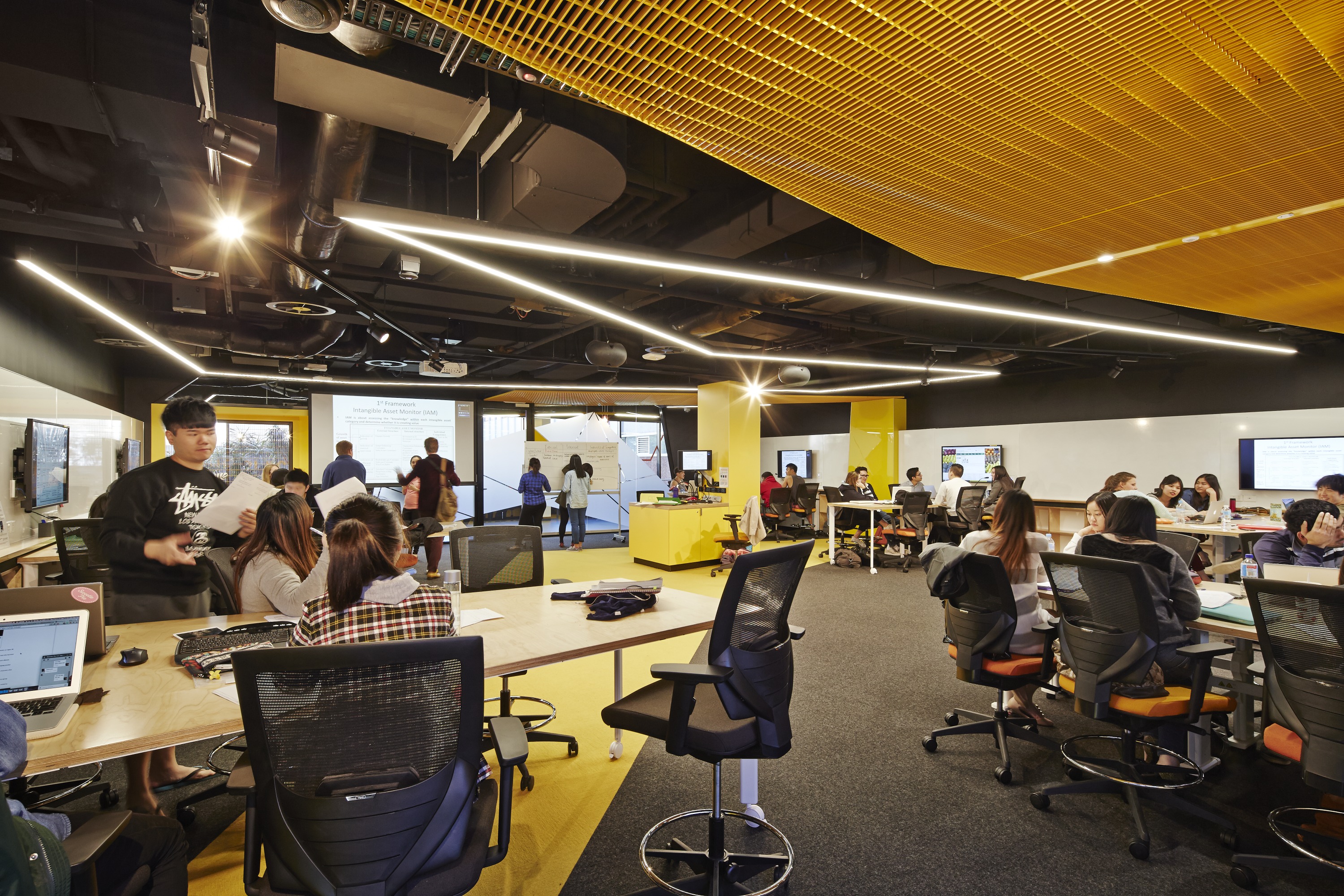
Flipped Classroom, UNSW Business School. Image: Woods Bagot
‘Collaborative’ or ‘Active’ Classrooms began appearing on higher education campuses at the turn of the 21st Century to support teachers practicing student-centred learning (for example, collaborative learning, project-based learning, problem-based learning etc). While the terms ‘collaborative’ and ‘active’ classroom are relatively interchangeable, they typically refer to a classroom comprising small group settings where students can work together, access technology (&/or connect their own devices) and in which the teacher is encouraged to move around the room to support student learning. The teacher may provide some instructional learning to the whole class, but then facilitate group work to apply new concepts through a range of student-centred learning activities. This was believed to encourage students to adopt a deep approach to learning.
In the first decade of the 21st Century, several funded research projects examined methods of evaluating Collaborative Classrooms, however these were complex to implement and raised further questions as to what can effectively be measured (Lee & Tan, 2011; Pearshouse et al., 2009; Radcliffe et al. 2009). These early POEs placed too much emphasis on attempts to prove the causal effect of Collaborative Classroom design with improved student learning outcomes. They essentially asked the wrong questions and unsurprisingly, POEs failed to get traction.
One POE tool is The Learning Space Rating System (Brandt, Brown et al, 2020), an extremely thorough form of post-occupancy evaluation comprising a 76-page instruction manual and excel spreadsheet. The complexity in completing an evaluation of one space would require days of effort and potentially engagement with specialist consultants to access architectural plans. Yet, there is no requirement to identify the potential learning behaviours to be enabled in the classroom.
I was concerned that the highest quality collaborative classroom does not guarantee a teacher will apply a student-centred approach to learning. My hypothesis was that if we could identify the behavioural characteristics of effective learning and teaching then we could evaluate if these behaviours are possible within the classroom. Instead of asking “Are students learning better?” the question I began asking was ”Is effective learning and teaching possible in the classroom?”
The Efficacy Rating
RateMyClassroom is an evaluation tool which evolved from my PhD study identifying the characteristics and behaviours associated with effective teaching and learning. One of the advantages of this tool is that it is quick and easy to use – students may evaluate a classroom as part of feedback to the university, a teacher may evaluate a classroom to check alignment with their teaching practice, or a designer may use the evaluation as a checklist for designing pedagogical flexibility, a predictor of educational efficacy.
The larger the dataset, the more consistent the outcomes and findings will be. When comparing a range of different classrooms through the same lens, the possibility for effective teaching and learning taking place in different classroom types becomes more significant. For example, the range of learning activities possible in the Flipped Classrooms at UNSW’s Business School (circa 2014) is considerably greater when compared to a typical tutorial room, lecture theatre or computer lab, leading to the conclusion that the UNSW Flipped Classroom enables effective teaching and learning to a far greater extent than typical classrooms commonly found on campus.
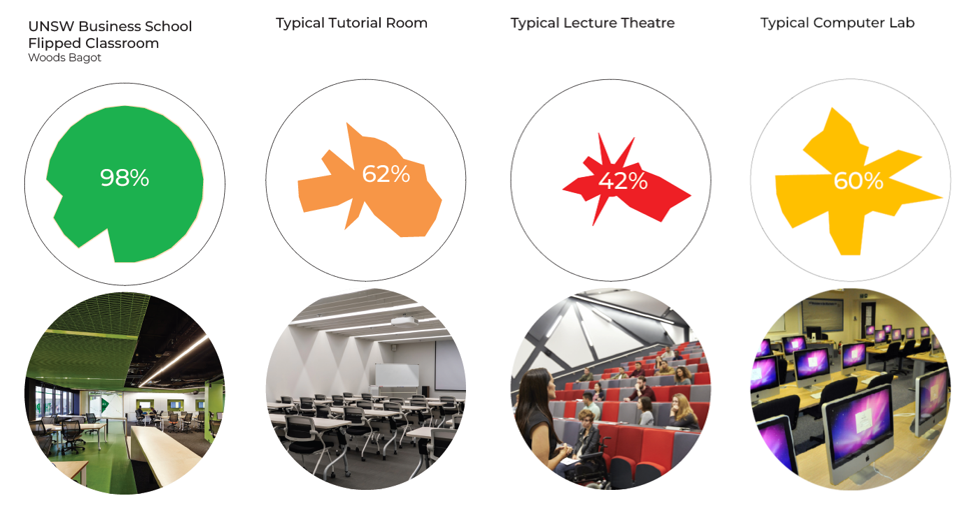
Comparison of RateMyClassroom applied to a range of formal classrooms.
The RateMyClassroom tool can retrospectively give universities the confidence that their investment in Collaborative or Active Classrooms enable teachers and students to experience student-centred learning. The tool can also predict positive teaching and learning experiences before a classroom is even built. Of course, there are other considerations that impact the design of classrooms such as capacity, area per person, natural light, and thermal comfort, however, classroom design should always start with thinking about pedagogy and the teaching and learning behaviours to be enacted within.
References
Brandt, B. et al (2020). Learning Space Rating System, 3rd edition. Available at: https://www.educause.edu/focus-areas-and-initiatives/teaching-and-learning-program/initiatives/learning-space-rating-system
Dane, J. (2020). New Generation Learning Environments in Higher Education. Monash University. Thesis. Available for download at: https://doi.org/10.26180/5e54abd1e7073
Lee, N. & Tan, S. (2011). Final Report 2011: A Comprehensive Learning Space Evaluation Model, Australian Learning & Teaching Council.
Pearhouse, et al (2009). JISC Final Report: A Study of Effective Evaluation Models and Practices for Technology Supported Physical Learning Spaces (JELS): University of Nottingham.
Radcliffe, D. (2009). A Pedagogy-Space-Technology (PST) Framework for Designing and Evaluating Learning Places. In D. Radcliffe, H. Wilson, D. Powell & B. Tibbetts (Eds.), Learning Spaces in Higher Education: Positive Outcomes by Design (pp. 11-16). St Lucia: University of Queensland.
Jo Dane is a campus strategist, working with education institutions to help plan their space requirements for the future. With a career spanning thirty years, Jo has worked as a designer, academic and now has her own consultancy business, Educology.
 Integrative Briefing for Better Design