What can the long-established profession of Architecture learn from Service Design, a design discipline that emerged in the early 90’s? As we navigate the future of professions in the context of rapid technological advancement, Laura Weiss discusses the opportunity for architects to draw upon the experience focused lens of Service Design to redefine the process of architectural design for successful outcomes.
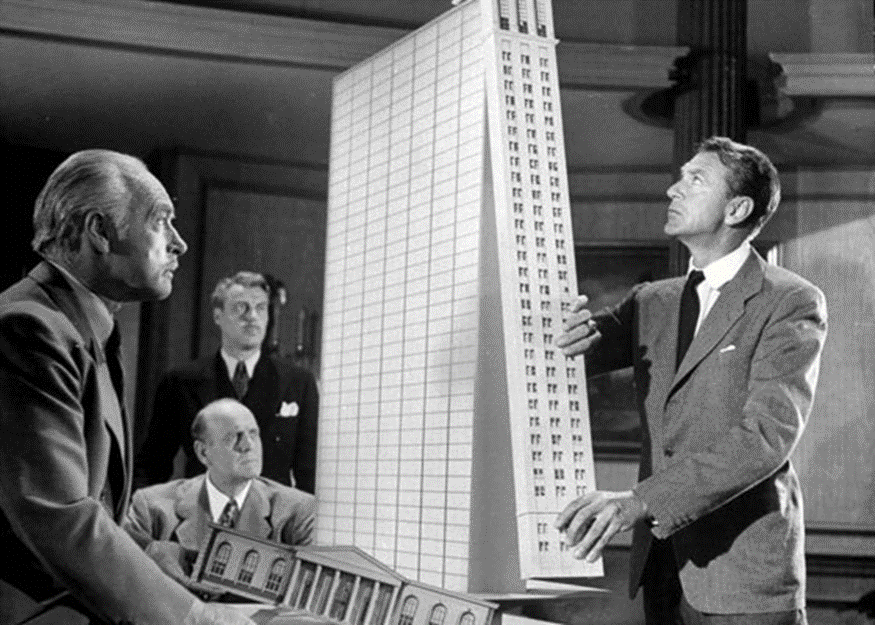
Image: ArchDaily Films & Architecture: “The Fountainhead”
Let’s face it: architects are service providers, not builders. Yet architects and the media almost exclusively focus on the building artifact as the primary source of value delivered, and firm portfolios as the primary differentiator. We rarely acknowledge (and provide minimal education for) the leadership skills required to guide clients and other stakeholders through a whole series of complex and often unfamiliar decision-making activities that affect a successful outcome. The overall experience of engaging with architectural services has evolved very little.
Therein lies a challenge and an opportunity. Clients don’t simply purchase or consume a service; they also participate in creating it – making it slower or faster, better or worse, cheaper or more expensive. Think about this during your next experience at an airline ticket counter, as you observe a frazzled agent tangle with an irate passenger. Architects also create service interactions – indeed, entire service journeys – that are mediated by one or more design artifacts (buildings in our case, aircraft in theirs). As a result, the service experience can heavily influence the overall value that the marketplace assigns to architectural services, just as it has for numerous organizations across a range of industries since formal approaches to service design emerged more than a decade ago.
Attention to service design is also a potential antidote to concerns that the architecture profession is ready to be disrupted by artificial intelligence and technological automation. In “Where Machines Could Replace Humans – and Where They Can’t (Yet)” (McKinsey Quarterly: July 2016), Michael Chui, James Manyika, and Mehdi Miremadi reference a study on the sectors and activities that are the most threatened by automation and those that are not. The article makes the point that examining activities, not occupations, is the more accurate lens for assessment, with activities that “require application of expertise to decision-making, planning, and creative tasks” being the least susceptible to disruption. To illustrate how service delivery can serve as a shield against automation, the article invokes the world of finance and its reliance on professional expertise. The potential exists for automation technology to support value creation in financial services, as it would allow bankers to “focus more of their time on advising clients rather than routine processing. Both the customer and the (banking) institution get greater value.”
What this suggests for the architecture profession is that it, too, has an opportunity to be much more deliberate in how clients and other stakeholders are engaged in the delivery of its work. Architects must take seriously the idea that they design and deliver a whole series of human interactions that create (or suppress) value long before a physical structure emerges. We must deliberately design those human interactions with the same care that we design the physical environment. If we cannot deliver value to our clients, we will not survive – not because of technology or economics, but because we did not recognize the importance of leading through service design.
This article was first published by arcCA (The AIA Journal of California).
Laura Weiss, CPCC, PCC is a creative and fearless facilitator, educator, and executive coach. She designs and delivers learning experiences for leaders who are motivated to create an improved future for themselves, their teams, their organizations, and the world by helping them get out of their own way.
 Integrative Briefing for Better Design
Pingback: The Key to Client Education | Integrative Briefing for Better Design
Pingback: Disrupting Practice: Findings from the Practice Innovation Lab | Integrative Briefing for Better Design