What do we mean by value? In this guest blog, Gary Adsett shares the “value-thinking” taking place at policy level in the development of independent schools across Queensland, Australia. He discusses how value-for-money is considered to maximise educational outcomes.

Caloundra Christian College. Architect: McLellan Bush.
I lead a Block Grant Authority that provides capital funds to Queensland independent schools to support their construction of new buildings and refurbishment of existing ones. The collective amount of funding distributed is significant, particularly when considered over a 10-year funding horizon. As with any investment, there is a desire to achieve a value-for-money outcome to maximise the return on investment. This funding is considered an investment toward the provision of high-quality student educational outcomes.
The value-for-money outcome has both an economic and a social outcome focus. In short, the economic focus seeks to ensure that the building is constructed on time and within budget, whilst also ensuring that the building’s whole-of-life costs are minimised. Social value is more complex. It involves ensuring that educational and architectural design are highly aligned. It seeks to ensure that spaces created are both safe and accessible. It also explores how buildings can be used by the community as a social infrastructure benefit.
Whether economic or social, the desired overall impact is to be student-centred, where teacher and student voices are elevated so that educational outcomes are maximised. Economically, dollars are saved so more funds can be allocated to teaching and learning. Socially, the built form contributes to the creation of an environment where students thrive and are granted the opportunity to be the best that they can be.
As built form is one of many factors that contribute to the desired impact, it can be difficult to determine its exact contribution. Furthermore, what is the correct measure to determine if it is making any contribution at all?
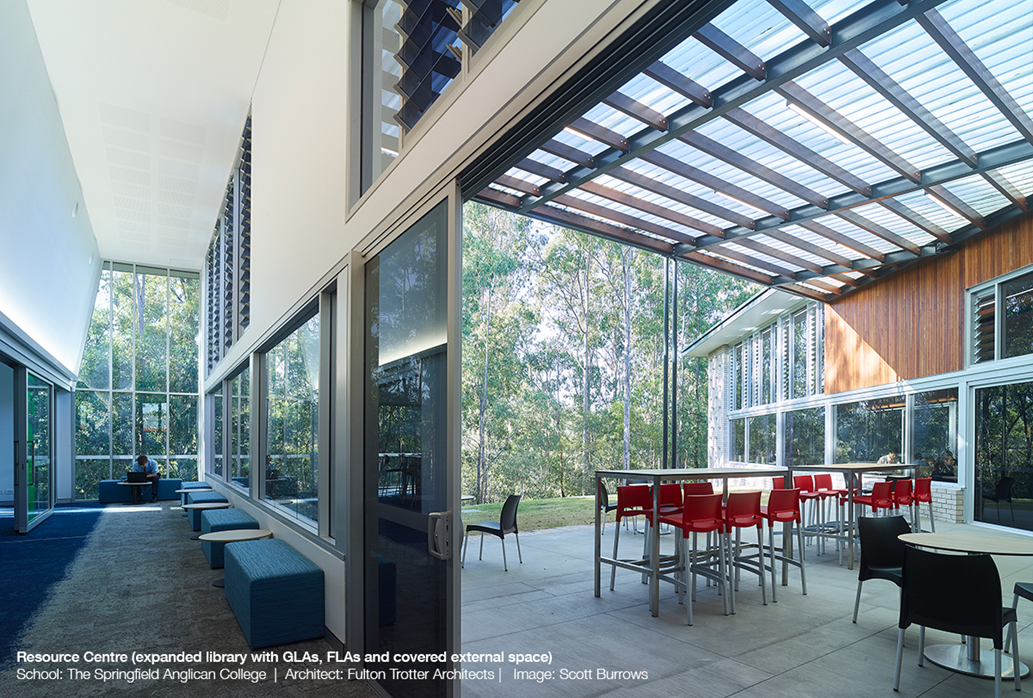
The Springfield Anglican College. Architect: Fulton Trotter Architects. Photography: Scott Burrows.
The approach taken to respond to this question has been two-fold. The first is the view that the level of capability and capacity that school leaders have to positively contribute to the design, construction and activation of a new or refurbished building is an indicator of contribution. That is, the greater the capability and capacity, the greater the contribution. The second is to undertake a post-occupancy evaluation (POE) to determine if a project is performing the intended function, and if not, to understand why. If this is discovered, our intent is to learn, rather than to invoke a penalty.
Our starting point for building capacity and capability is meeting with school leaders to understand their context, and then to provide them with information that supports them to make their own decisions relating to their projects. This interaction is described as relational. Beyond this point is the quest to be transformational, where school leaders are given resources to upskill their capability and capacity. Examples (both in practice and in development) include deep dives into subjects such as environmental frameworks and project feasibilities; a photo library of constructed projects to inspire creativity and ideas for future projects; and toolkits to identify design principles for master plan and construction projects; and provide both a process to develop a master plan and a baseline of what should be in it.
Three key fundamentals underpin the development of these resources. The first is the importance of being human-centred and applying a design thinking approach. This is demonstrated through the collective involvement of architects, project managers and educators in the development of our tools. The second is that the best money and time spent on a project is at the start. The message is to not scrimp at the start of the project, and not to be afraid to iterate and prototype to ensure alignment between strategy, strategic master plan and construction project. The last fundamental is to ensure that educators are equipped to obtain mastery in the newly constructed spaces.
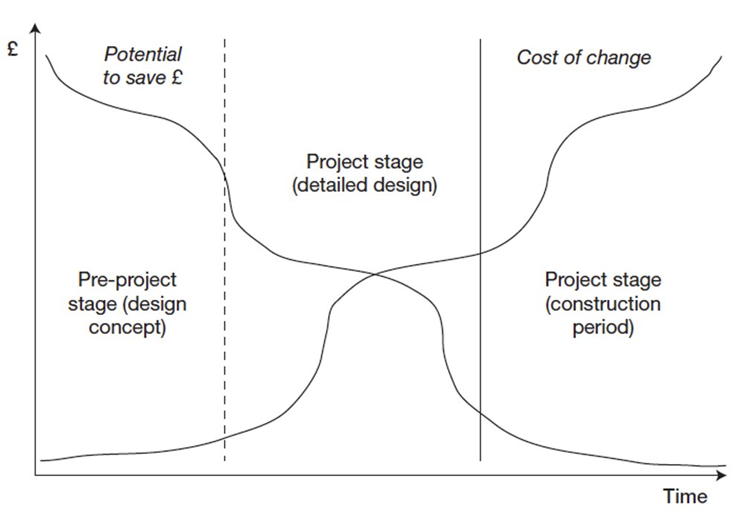
Careful planning at the start can result in major cost benefits later. The potential to save money reduces and the cost of making changes to the project increase as the project progresses. Source: DEGW
Our transformational approach is still in its infancy, so it will be interesting at a future point in time to look back and determine whether lifting school leader capability and capacity combined with post-occupancy evaluations do indeed make an impactful contribution.
Gary Adsett is the General Manager of the Queensland Independent Schools Block Grant Authority. Prior to taking on this role in September 2022, he was Group Manager, Social Impact, YMCA of Queensland and Board Chair of The Lakes College. He has extensive experience in the design, construction, and activation of educational, community and residential facilities.
 Integrative Briefing for Better Design