Reflecting on his experiences from briefing for a building, to selecting an architect, to being a Professor of Architecture, David Porter discusses the shift from a jargonistic approach to architecture, to a richer and more nuanced view of the relationship between the environment and inhabitants.
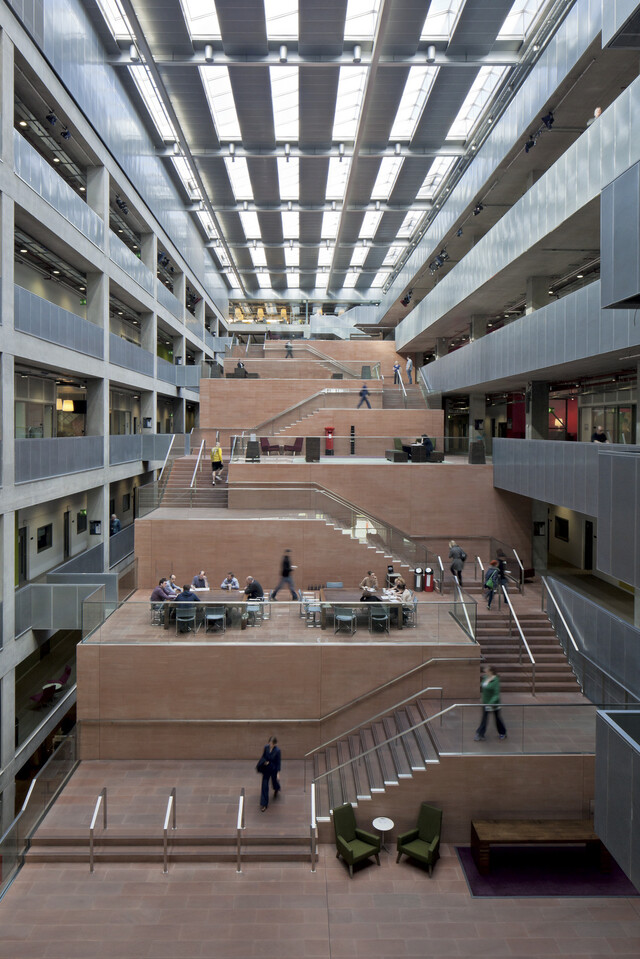
Image: BBC Scotland Headquarters, David Chipperfield Architects.
When I was a student, I learned that buildings have “users” – I now see this as misleading and meaningless jargon – we are inhabitants.
A speculative reflection in three parts – with learning carried over between each:
Part 1. The competition for a new headquarters for BBC Scotland, where I was a member of the selection panel.
Part 2. Glasgow School of Art (GSA), where I was a member of the briefing team, and member of the panel selecting an architect for the new Reid building, incorporating learning from the BBC competition. In both these institutions the personnel can be characterised as ‘creatives’, ‘technicians’, ‘administrators’, and ‘management’. Each with its own protective jargon. In a school of art there are students, often referred to as ‘consumers’ but in fact, they are co-creators.
The Reid Building, Glasgow School of Art. Architect: Steven Holl Architects.
Part 3. As a professor of the Central Academy of Fine Art (CAFA), Beijing, where I ran a research seminar for postgraduate students exploring how cities and the buildings within them are inhabited on a day-to-day basis.
This seminar was inspired by a joint briefing paper I prepared for the Reid building with the GSA’s Irene McAra McWilliam, professor of Design, and Klaus Jung Professor of Fine Art on the role of the studio in creative education in our respective subjects. We concluded that: “Studio is a place, a field of potential, an activity and an ethos.” Working together, insisting on a jargon-free approach to describing direct experience, we realised that the city of Glasgow could itself be conceptualised as a ‘studio’ – one that we shared with its citizens. That we were citizens of the studio, or at least, inhabitants. Our students were our co-creators.
My research seminar at CAFA was inspired by this collaborative approach to the studio. My students used photography and video, inspired by William H. Whyte’s film ‘Social Life of Small Urban Spaces’, and referred to selective writing of Walter Benjamin, for example, “Buildings are used as a popular stage. They are all divided into innumerable, simultaneously animated theatres. Balcony, courtyard, window, gateway, staircase, roof are, at the same time stages and boxes”[1]. And by the writing of social Anthropologist Tim Ingold[2]. This was to help students break from the inherited jargon they were using and engage with the world.
City Spaces, Human Places. Based on “The social life of small urban spaces,” a film by William H. Whyte.
By this time, I had rejected the jargon I had been taught – that buildings have ‘users’ – to explore a more nuanced (and biologically, psychologically, and anthropologically more appropriate) approach adopting JJ Gibson’s theory of affordances, which states that the world is perceived not only in terms of object shapes and spatial relationships but also in terms of object possibilities for action (affordances), indeed that perception drives action.
And with this, that all learning is environmental.
[1] One Way Street, Walter Benjamin.
[2] The Perception of the Environment, Essays in livelihood, dwelling and skill., Tim Ingold.
David Porter is an Emeritus Professor of the Mackintosh School of Architecture at the Glasgow School of Art and visiting professor at the University of Westminster.
 Integrative Briefing for Better Design