Sarah Backhouse has spent 20+ years briefing and evaluating workplace and learning environment projects, focusing on their sociocultural environments as much as their constructed environments. Increasingly, health and wellbeing feature as building project objectives. However, “health and wellbeing” is often a catchall term, interpreted differently across individuals, cultures and professions. This short post explores the nexus between integrative briefing and mental wellbeing.

Mental Wellbeing
Mental wellbeing and mental health are distinct concepts yet frequently conflated. Mental health spans a continuum from mental illness to good mental health, and mental wellbeing spans from languishing to flourishing[i]. This dual continuum model[ii],[iii] explains why mentally healthy people sometimes struggle, and those with mental illness can thrive with environmental support. Promoting mental wellbeing is a positive goal across contexts as it underpins people feeling good and moving towards their full potential; it also has a protective dimension.
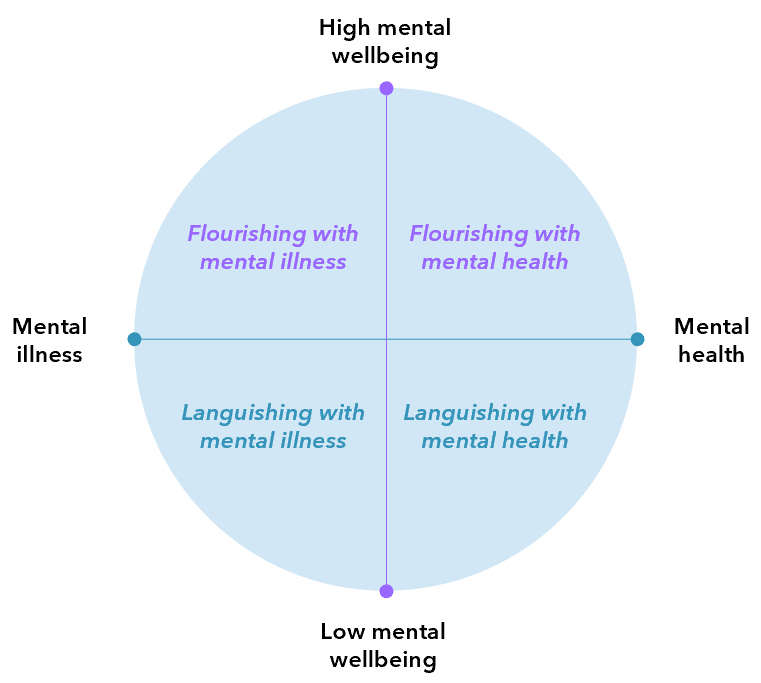
Figure 1: The dual continuum model.
A cornucopia of models exists for promoting mental wellbeing. For example, PERMA[iv] proposes positive emotions, engagement, relationships, meaning, and accomplishment as the five critical levers of wellbeing, informing wellbeing strategies in schools and workplaces. Alternatively, FLOURISH[v] takes an ecological view of child, family, community, society, and the built and natural worlds, including contribution, growth, relationships, engagement, fulfilment, independence, and security. Identifying a suitable model depends on the context.
Importantly, research shows that scaling up the promotion of mental wellbeing requires a systems approach[vi]. Integrative briefing adopts a systems approach by considering a built environment project’s natural, sociocultural, and constructed environment: the collective environment[vii]. Integrative briefing is also cyclical, iterative and reflective, offering multiple moments and environments for wellbeing promotion. So, how might an integrative briefing process promote mental wellbeing?
Promoting Mental Wellbeing via Integrative Briefing
Although many factors influence mental wellbeing, a solid evidence base shows that the basic psychological needs (BPN) of autonomy, relatedness (belonging) and competence are essential nutrients across contexts and cultures[viii]. Therefore, these three needs offer basic principles – think of them as the ABCs – for intentionally promoting mental wellbeing across the integrative briefing process[ix].
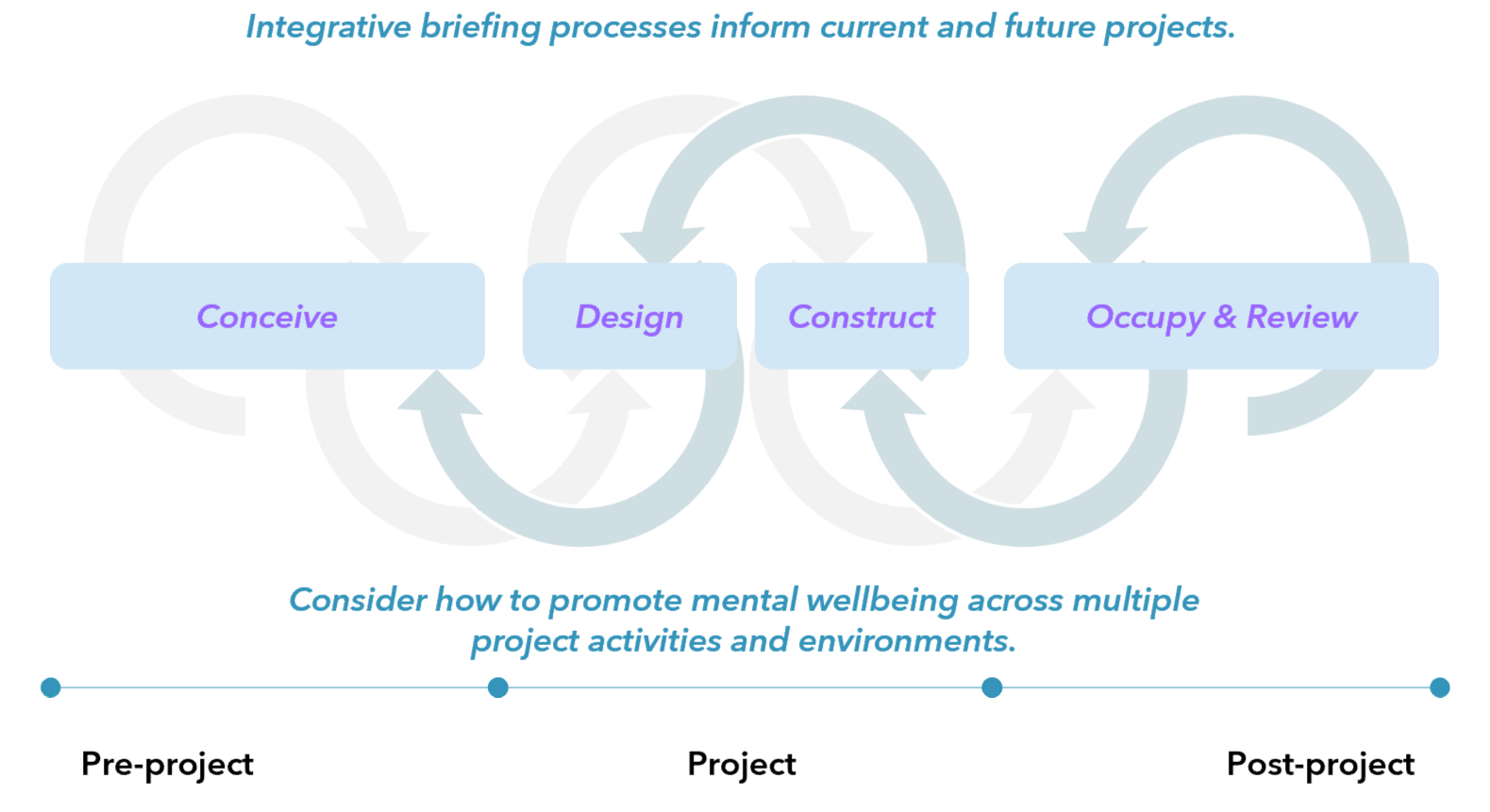
Figure 2: Integrative briefing is iterative and reflective.
- Participatory approaches can support the BPN by inviting stakeholders (e.g. future occupants) to inform design outcomes that affect them (autonomy-supportive), collaborate for collective benefit (relatedness-supportive) and share their lived experience or expertise (competence-supportive).
- Constructed outcomes can support occupants’ BPN by offering choice and diversity (autonomy-supportive), visual cues and spatial/functional adaptability (competence-supportive) and spaces for social connection (relatedness-supportive) when aligned with the sociocultural environment (e.g. are occupants enabled or permitted to use the spaces as designed or needed?).
- Evaluation approaches can include measures for BPN support and mental wellbeing outcomes, such as the Warwick-Edinburgh Mental Wellbeing Scale[x] and the Building Wellbeing Scale[xi]. Insights can then inform future project knowledge about the attributes and alignments of sociocultural and constructed environments that contribute to occupant mental wellbeing.
This post has merely brushed the surface of a complex and vital topic. Likely, you are already working in ways that promote mental wellbeing in your project processes and built outcomes, whether intended or serendipitous. Yet, scaling up the promotion of mental wellbeing requires intentionality. As suggested here, integrative briefing offers a potent framework for creating mental wellbeing-promoting systems and environments – be they sociocultural or constructed – when guided by an ABC mindset and contextually appropriate wellbeing strategies. I’d love to hear how you intentionally promote mental wellbeing in your contexts and built environment projects.
[i] Keyes C. L. (2007). Promoting and protecting mental health as flourishing: A complementary strategy for improving national mental health. The American Psychologist, 62(2), 95–108. https://doi.org/10.1037/0003-066X.62.2.95
[ii] Westerhof, G. J., & Keyes, C. L. (2010). Mental Illness and Mental Health: The Two Continua Model Across the Lifespan. Journal of Adult Development, 17(2), 110–119. https://doi.org/10.1007/s10804-009-9082-y
[iii] Backhouse, S. (2023) The dual mental health continuum for architects. https://doi.org/10.26188/24080430.v1
[iv] https://ppc.sas.upenn.edu/learn-more/perma-theory-well-being-and-perma-workshops
[v] https://www.flourishproject.net/uploads/1/8/4/9/1849450/understanding_the_flourish_model_july_2018.pdf
[vi] Kern, M.L., Williams, P., Spong, C., Colla, R., Sharma, K., Downie, A., Taylor, J.A., Sharp, S., Siokou, C. & Oades, L.G. (2020) Systems informed positive psychology. The Journal of Positive Psychology, 15(6), 705-715, https://doi.org/10.1080/17439760.2019.1639799
[vii] https://parlour.org.au/social-impact/integrative-briefing-for-better-design/
[viii] https://selfdeterminationtheory.org/topics/application-basic-psychological-needs/
[ix] Backhouse, S. (2023) Promoting Mental Wellbeing via the Integrative Briefing Process. https://doi.org/10.26188/24079635.v1
[x] Tennant, R., Hiller, L., Fishwick, R., Platt, S., Joseph, S., Weich, S., Parkinson, J., Secker, J., & Stewart-Brown, S. (2007). The Warwick-Edinburgh Mental Well-being Scale (WEMWBS): Development and UK validation. Health and Quality of Life Outcomes, 5, 1-13. https://doi.org/10.1186/1477-7525-5-63
[xi] Watson KJ. (2018) Establishing psychological wellbeing metrics for the built environment. Building Services Engineering Research and Technology. 39(2):232-243. https://doi.org/10.1177/0143624418754497
Sarah Backhouse is an Australian architect, researcher and wellbeing specialist with a background in briefing, designing and evaluating workplaces and learning environments. Given her interest in people and places, Sarah’s PhD is exploring the intersection of architects, architecture and the psychology of wellbeing.
 Integrative Briefing for Better Design